
Oxnard · Masonry Services
Stone Masonry
Flagstone patios, stone walls, boulder settings, stone steps and cobblestones, laid by hand and fitted on site.
Stone Masonry · Oxnard
Natural Stone, Set by Hand
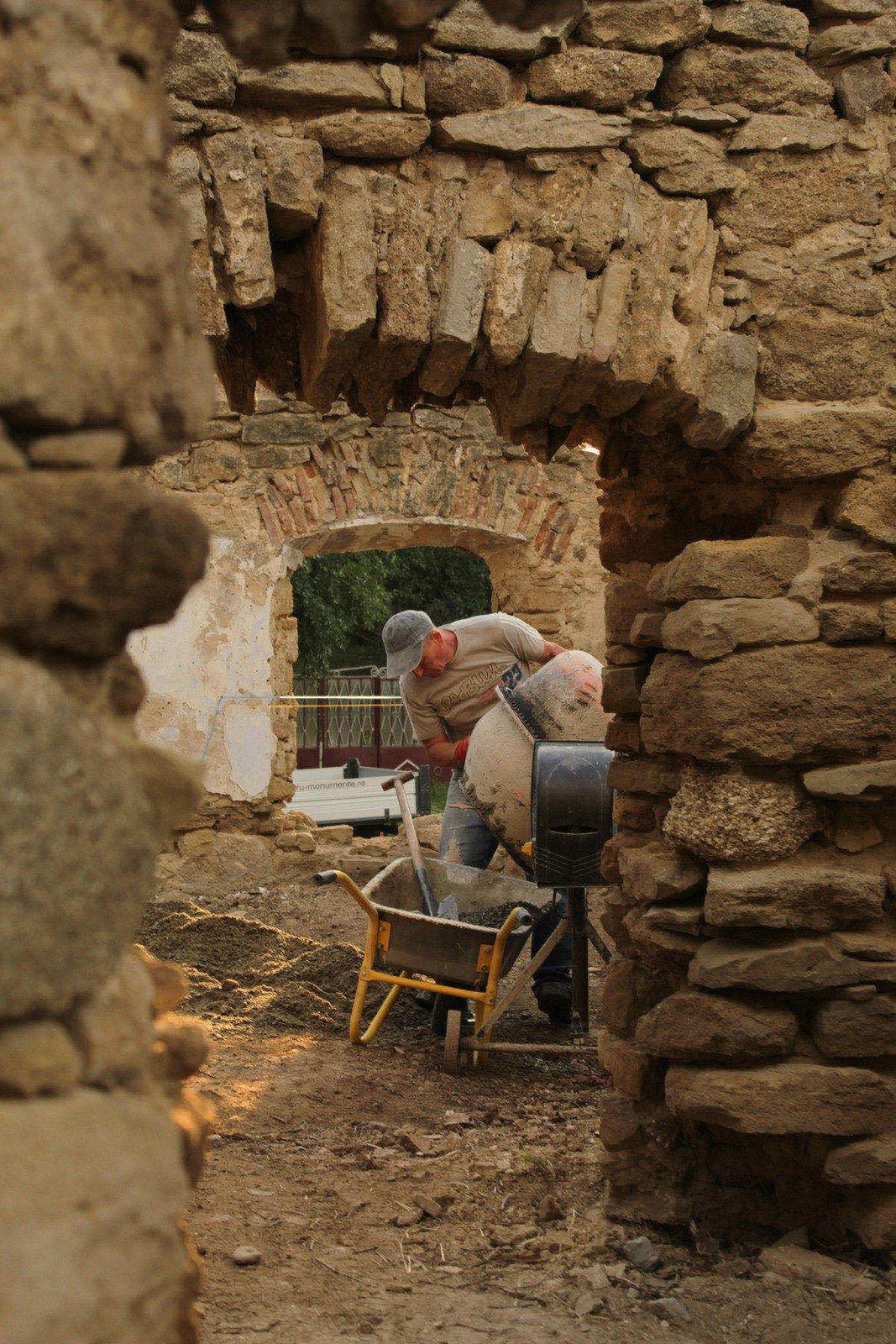
Stone masonry is the slowest work we do and the work that lasts longest. Every piece is chosen, turned, sometimes cut and then set, which is why a stone wall reads differently from anything manufactured. We build stone walls both freestanding and as facing over a structural core, lay flagstone patios and walkways, set boulders as retaining features and as landscape anchors, cut stone steps into slopes, and install cobblestones for driveways, borders and entry courts. Ojai and the Ventura hillsides are where most of this work goes, though it turns up everywhere once a homeowner has seen it on a neighbor’s property. Where a wall has to hold real load we build the structure in block and face it in stone, which is covered under Retaining Walls. Where the stone is a surface rather than a structure, the base work matters as much as it does under Pavers, and we build it the same way.
Why Homeowners Bring Stone Work to Us
Stone rewards patience and punishes speed. A wall laid quickly shows it in the joints, in the repeating faces and in the way the courses drift out of level along a run. Our masons fit stone dry before they set it, keep the joint widths consistent, and turn the good face out even when that means cutting the back. It takes longer, and it is the only reason a stone wall looks hand-built rather than glued. The same crew handles brick and stone masonry across Ventura County, so the person setting your stone has laid a few thousand square feet of it before.
- Stone dry-fitted before it is set, so faces and joints work together.
- Local and regional stone sourced to suit the property rather than a catalog.
- Full-bed stone where structure allows it, thin veneer where weight does not.
- Boulders placed with equipment and then adjusted by hand until they sit naturally.
- Flagstone laid on a compacted base with the joints detailed for drainage.
- Existing stone work matched when we extend or repair it.
Reasons to Choose Stone
Stone is the right answer more often than people assume. The cases where it clearly wins:
You want the yard to look like it grew there
Boulders and dry-laid stone read as landscape rather than construction. On Ojai and hillside Ventura properties, a stone wall settles into the setting in a way that a gray block wall never manages, however well built it is.
The surface has to handle weather and traffic
Flagstone patios take heat, rain and furniture for decades with almost no maintenance. Stone steps outlast timber and concrete alike, and they never need refinishing.
You need grade change that also looks good
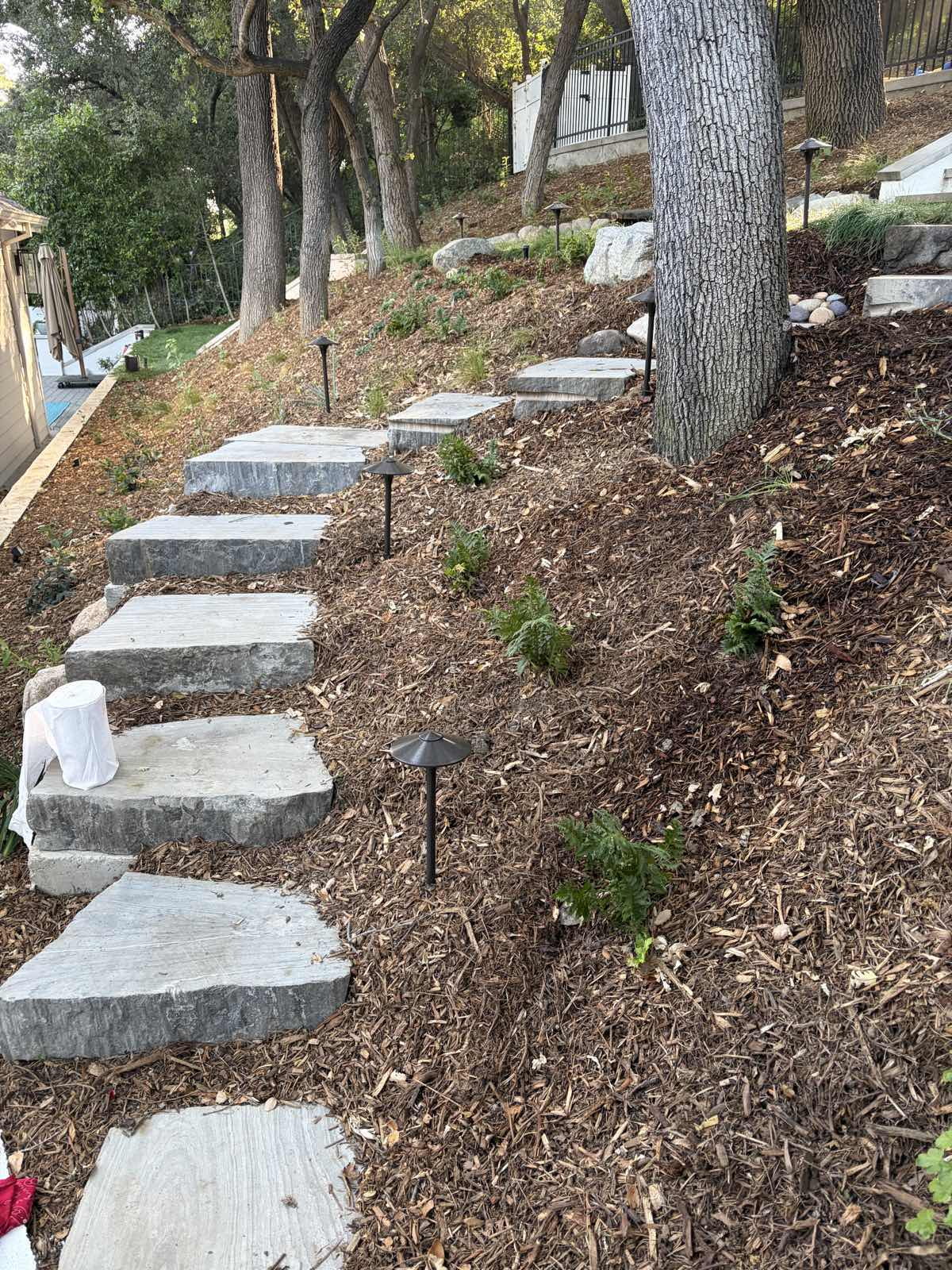
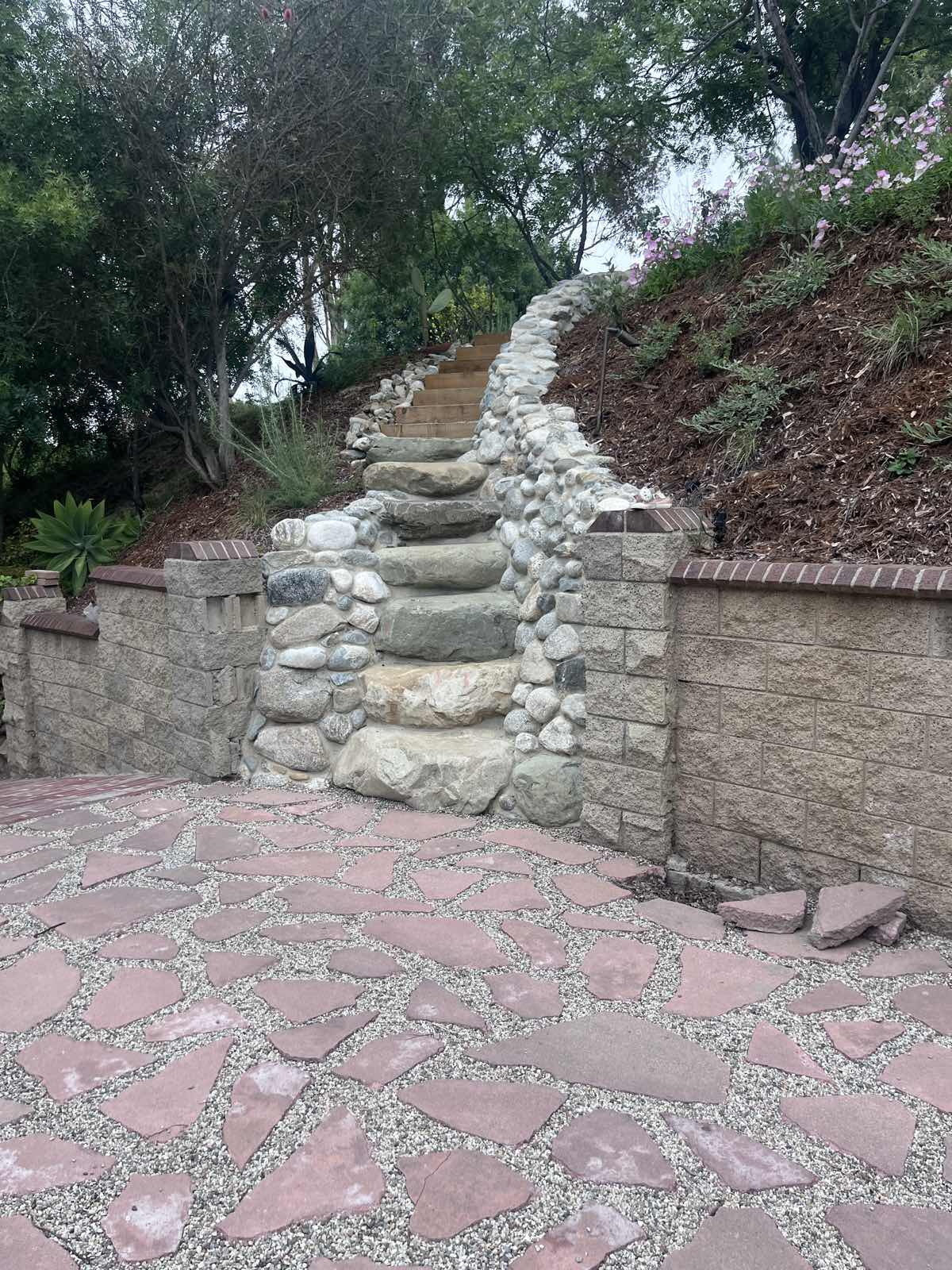
Stone steps cut into a slope, with boulder cheeks either side, solve a circulation problem and a visual one at once. That combination is most of what we build on the properties up the Ojai road.
The house is stucco or Spanish revival
Stone is the traditional companion to both, at the base of a wall, around an entry, or as a low garden wall along the drive. It also pairs cleanly with brick, so both often appear on the same property under Brick Laying.
You are in a fire hazard zone
Stone does not burn. On properties backing onto open space in Newbury Park, Thousand Oaks and the upper Ojai valley, replacing combustible landscaping near the house with stone or cobblestone is a real reduction in risk.
You want something with no replacement date
Timber will need replacing. Composite will fade. A stone wall built on a proper footing is still there in a hundred years, which is why so much of what we repair in Santa Paula is stone and brick from the 1920s.
Send a photo of the area and the house, and we will bring stone samples out so you can see them against your own walls in daylight. Call: 805-301-6837
How We Work
From the first walkthrough to the final cleanup, the same crew is on your property.
1. Selection and layout
We walk the property, look at the house material and the light, and put together two or three stone options with samples. Layout is marked on the ground with paint and a hose line so you can see the shape and walk it before anything is dug.
2. Base and structure
Patios and walkways get excavation, compacted aggregate base and a bedding layer. Walls get a poured footing below frost-free depth with steel through it. Boulder work gets a keyed bench cut into the grade so the rock sits into the hill rather than on it.
3. Setting and pointing
Stone is laid out on the ground, fitted dry, then set in mortar or dry-stacked depending on the design. Joints are pointed and brushed back to the face, and the whole surface is cleaned down. On wet-set patios we point the joints once the stone has settled.
Stone Work We Take On
The stone jobs we build most across the county:
Flagstone patios
Irregular or cut flagstone laid dry on a compacted base with sand or gravel joints, or wet-set over a concrete slab with mortared joints. Dry-laid drains better and can be lifted; wet-set is firmer underfoot and easier to sweep.
Stone walls
Freestanding garden walls, veneer over block, and dry-stacked walls where the setting suits them. Cap stones are selected individually because the cap is what everybody looks at.
Boulders
Placed as retaining features, as terracing on a slope, or as landscape anchors around a planting bed. Each boulder is buried to about a third of its height so it looks settled rather than dropped.
Stone steps
Solid slab treads or built-up stone risers cut into a grade, set on compacted base with consistent rise and run so they are comfortable in the dark. Handrail cores are set at build time when the run needs one.
Cobblestones
Cobblestone borders, aprons, driveway bands and full entry courts. Cobbles handle vehicle loads well and give an older property a driveway that suits its age.
Stone veneer
Full-bed or thin veneer over framed and block walls, chimney chases and house bases, installed over a proper drainage plane with flashing so water that gets behind it can leave.
What Affects the Cost of Stone Masonry
Stone is priced by the square foot and by the hand time it takes to fit. What moves the number:
- Stone type. Local fieldstone and standard flagstone sit at the practical end; specialty and imported stone can double the material line.
- Full-bed versus veneer. Natural stone veneer installation costs roughly half what solid stone does, because you are buying an inch or two rather than four to six.
- Fitting time. Irregular stone laid tight takes far longer than sawn stone laid to a grid, and labor is most of a stone bill.
- Base work. A patio over a properly compacted base costs more than one thrown on soil, and it is the difference between a flat patio and a rocking one.
- Access. Stone is heavy. If it has to be barrowed a hundred feet down a side yard, that shows up in the estimate.
- Structure underneath. Where stone faces a wall that also has to retain soil, the wall is engineered and priced on its own merits first.
You get a flat written number after the walkthrough, with material, base, setting and cleanup inside it. Stone patios are often quoted alongside a Concrete slab or footing where one is needed underneath.
Frequently Asked Questions
What is the difference between natural stone and stone veneer?
Full-bed stone is real masonry: three to six inches thick, heavy, and needing something underneath to carry that weight, usually a footing or a steel ledge. Veneer is a one to two inch facing bonded to a prepared wall, light enough to go straight onto existing block or framing. On installed cost, veneer is around half. To tell which a wall is, look at an outside corner and a window return, because that is where veneer has to be detailed around its own thinness.
What type of stone is best for exterior walls?
Granite and quartzite stand up to exposure best, with hard limestone close behind. Sandstone reads warmer and cuts more easily, but it gives up its surface faster, and the salt-laden air coming off the Channel accelerates that on any wall near the coast. Further inland around Camarillo and Moorpark, the softer stones are a reasonable choice. We bring samples to the property so you can see them in your own light before deciding.
Does a flagstone patio need a concrete base?
Not necessarily. Dry-laid flagstone on a compacted aggregate base drains freely, can be lifted and reset, and suits most yards. A concrete base with mortared joints gives a firmer, flatter surface that is easier to sweep and better under furniture, and it is the right call over a poor subgrade or where the patio has to stay dead level against a house.
Planning masonry work in Ventura County?
Send a few photos and rough measurements and we will come back with a written estimate at no charge.
Or call us now: 805-301-6837